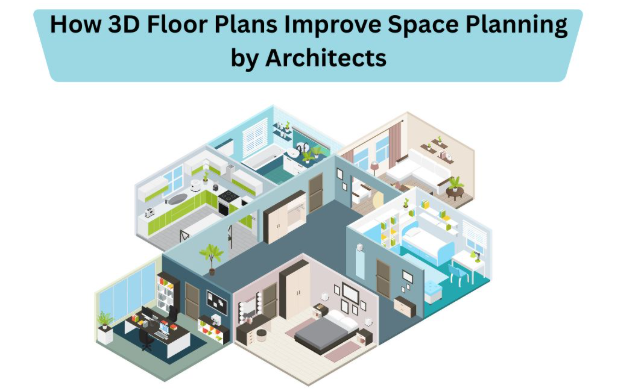
Space planning is one of the most critical aspects in architecture. Whether a dwelling, an office space, or a large project, an architect needs to be keen on designing it and should keep the essentials in mind. Along with the functionality, he must consider aesthetic issues while navigating around the space. But in most cases, it can be utterly misleading with the use of two-dimensional illustrations and is not very informative, either. Here is the benefit of 3D floor plan services.
With the ability to transform two-dimensional designs into dynamic, realistic images, 3D floor plans give architects the power to investigate space in a way that was unimaginable with two-dimensional designs. As a tool rendered from a reliable 3D architectural rendering company, this technology adds immense value to space exploration, communication, and decision-making during design phases.
The following is how 3D floor plan services can hugely benefit space planning in architecture.
1. Instant Spatial Clarity and Realistic Scale
One drawback of traditional 2D designs is that clients and sometimes even team members need to interpret symbols, measurements, and geometric concepts. There isn’t such a problem with 3D floor plan solutions because they depict spaces in such a self-explanatory manner.
They will benefit if they understand:
- Room proportions
- Measuring furnishings
- Circulation paths
- Distribution of functional zones
- Spatial relationships
Being able to view these elements in realistic proportions makes it easier to hone in on both the page layouts and space efficiency.
2. Improving Flow and Circulation Analysis
Well-designed spaces depend a lot on the circulation of people within them. While 2D designs make it difficult for people to make out the pathways of circulation, 3D designs are those through which pathways of circulation can be easily observed.
With a 3D visual, architects can:
- Bottleneck identification
- Optimize the width of hallways
- Improve transitions between rooms
- Clearly distinguish between public and private areas
The presence of such functions allows one to design efficient, comfortable, friendly layouts.
3. Improving Furniture Arrangement & Interior Spaces
Poor scale or placement of furniture can make or break a space by breaking traffic paths, creating congestion, or inefficiency within the spaces. 3D floor plan solutions help architects use precise furniture arrangement simulations.
Such images help architects in:
- Verify ideal dimensions for furniture
- Assess walkways in relation to furniture
- Optimize seating groups, storage, and workspace regions
- Use multiple configuration layouts
By pre-viewing how furnishings interact with architecture, designers can better hone space efficiency before completion of designs.
4. Reducing Design Errors Before Construction Begins
Small errors in planning could mean very expensive corrections once construction is in full swing. 3D floor plans help architects recognize these errors before they become construction errors.
Some of the problems detected in the renderings include the following:
- Awkward door swings
- Insufficient clearance space
- Misaligned fixtures
- Poor Light Placement
- Ineffective room proportions
A professional 3D architectural rendering service will ensure all aspects are correct to help prevent delays and cost overruns during the project execution.
5. Simplification of Communication with Clients & Stakeholders
The clients also can’t conceptualize the spaces from technical drawings, which sometimes leads to misunderstandings and modifications of designs.
3D floor plans allow architects to communicate their designs more clearly.
What clients can understand immediately is:
- How their future space will look
- Whether it meets their requirements in respect of page layout
- Usability Impact of Design Choices
- What areas may need to be overhauled?
This clarity provides an easier way of approval, fewer miscomprehensions, and thus more speed in the design process.
- To Support a Comparison Among Various Options
Architects will usually study several designs before opting for the best. If the design is 2D, it might be perplexing to compare other designs side by side. A 3D floor plan service can make it quite easy.
Comparison is especially informative when viewing:
- Variations in room design
- Collateral circulation pathways
- Various styles of interior decoration
- Various possibilities of furniture arrangement
With this, architects and clients will be confident in choosing the most effective and appropriate design.
7. Enhanced Collaboration Between Design Teams
Interior designers, engineers, and construction contractors all typically take part in an architecture project. 3D floor plans make it easier to give everyone a common understanding of what is to be expected.
Teams benefit via:
- Well-defined guidelines are available for structural aspects
- A shared understanding of interior spaces
- Less dependent on technical building
- Smooth communication during revisions
When all sides see the same realistic picture, teamwork is achieved with an increased degree of accuracy.
8. Support towards better Material and Finish Planning
Textures, the type of flooring, and even color schemes make a big difference in the way a space will feel. Realistic finishes can be added in 3D floor plans so that architects can better assess design aesthetics.
This helps architects with the following:
- Test different combinations of materials
- Color Transfer Displayed by Rooms
- Make sure stylistic uniformity is observed
- Assess the interaction of light with surfaces
This information supports architects in making good design decisions within the early stages of the planning phase.
Conclusion
The services in 3D Floor Plans change the conventional way of doing space planning for architects by providing realistic and intuitive views of designs that further enhance clarity and accuracy in designs. From circulation path analysis to communication with the client, 3D Floor Plans make all design procedures simpler and more efficient.
Collaboration with a professional 3D architectural rendering company will enable these elements to be detailed, accurate, and related to project objectives. With increasing visual nature in architecture designs and a focus on client requirements, 3D floor plan services have become nothing less than a sheer necessity for effective and functional designing of thoughtfully well-structured spaces.